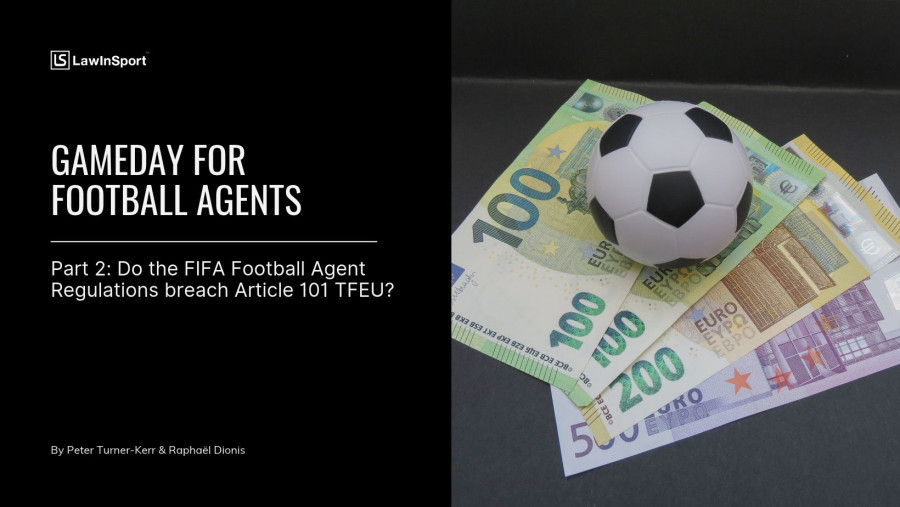
Gameday for Football Agents: do the FFAR rules breach Article 101 TFEU? (Part 2)
This[1] is Part 2 of a series of four articles on the 2026 ROGON[2] (C-428/23) and RRC Sports[3] (C-209/23) rulings by the Court of Justice of the European Union (CJEU). Part 1 (see here) introduced the two judgments and examined ROGON. RRC Sports concerns the FIFA Football Agent Regulations (FFAR), a new regulatory framework for football agents operating in the international transfer system, which introduced (among other rules) a mandatory licensing regime for football agents, caps on the fees that they can charge for their services, and restrictions on representation by the same agent of multiple parties to the same transfer.
This article turns to the core competition law questions in RRC Sports: whether the FFAR rules restrict competition by object; how they fare under the Wouters/Meca-Medina exception (the line of case law under which rules pursuing a legitimate public-interest objective fall outside Article 101 of the Treaty on the Functioning of the European Union (TFEU) where they are necessary and proportionate to achieving that objective);[4] and the application of Article 101(3) TFEU (exemption for restrictive agreements whose benefits outweigh their harm).
Article Outline:
- Passing the by-object test: how the FFAR mostly stay onside
- The rules that survive the by-object test
- Legitimate objectives: acceptable justifications under Wouters/Meca-Medina
- Table summarising the legitimate justifications under Wouters/Meca-Medina recognised by the CJEU
- Exemption under Article 101(3): can the by-object rules be saved?
Note: The authors formed part of the team that represented FIFA in the RRC Sports case.
To continue reading or watching login or register here
Already a member? Sign in
Get access to all of the expert analysis and commentary at LawInSport including articles, webinars, conference videos and podcast transcripts. Find out more here.
- Tags: Antitrust_Competition & EU | Court of Justice of European Union | European Union | FIFA | FIFA Football Agent Regulations | Football | Treaty of Functioning of the European Union (TFEU)
Related Articles
- A Guide to the new FIFA Agent Regulations For Football Agents & Clubs
- The Global Trend Of Action Against No-Poach And Wage-Fixing Agreements In Sport
- UEFA Home-Grown Player Rule EU Law Challenge – Royal Antwerp FC V Royal Belgian FA
- Understanding FIFA’s Agents’ Regulations - Experts’ Discussion
- Working as a football agent in Italy: Complying with the FIFA's Football Agent Regulations & Italian law
- Football agents (PROFAA) v FIFA – CAS’s biggest EU competition law decision yet?
- The end of the FIFA Agents Cap and the beginning of a less restrained standard of competition review in sport?
- Regulating the Regulators: Competition Law Takes on FIFA’s Agent Rules
- Indefinite provisional suspensions and competence under the FFAR: CAS Panel reinstates suspended agent licence in Tullio Tinti v FIFA
- When Safety Rules Collide with Competition Law - The UCI Gear Ratio Decision
- Sport & Competition Law – Annual Review 2025/26
- Beyond the Super League: How the Madrid Ruling and Competition Law Are Reshaping Sports Governance
- When Is a No-Poach Agreement a ‘By-Object’ Restriction? Lessons from Tondela (Part 1)
- Can a No-Poach Agreement Be Justified? The Legitimate-Objective Route in Tondela (Part 2)
- When can sports federations sanction club directors? Review of CJEU ruling - Part 1
- When is a sports body a “court or tribunal” under EU law? Review of CJEU ruling - Part 2
- Gameday for Football Agents: The road to Luxembourg and the ROGON judgment (Part 1)
Written by

Peter Turner-Kerr
Peter Turner-Kerr joined the firm in 2019 from the Australian Competition and Consumer Commission (ACCC), where he was a Director in the Merger Investigations Branch and led a number of significant merger reviews, including, for example, the Siemens-Alstom and Tronox-Cristal transactions.